
Net Metering to Net Billing in Pakistan (2026)
What changed when NEPRA replaced Net Metering with Net Billing on 9 February 2026, and what it means for existing and new solar consumers across every DISCO.
In this guide9 sections
- How Net Metering Worked (Before 9 February 2026)
- What Changed on 9 February 2026
- Public Reaction & the Prime Minister’s Intervention
- The Amendment: What’s Actually Protected
- Eligibility & System Requirements
- August 2026 Update: NEPRA Orders Billing Fixes for Stuck Applications
- What It Means for You
- FAQs
- In Short
For years, solar consumers across every DISCO benefited from Net Metering under NEPRA’s 2015 regulations. That changed on 9 February 2026, when NEPRA introduced the Prosumer Regulations, 2026, replacing Net Metering with Net Billing — a shift that triggered public criticism and eventually direct intervention from the Prime Minister. Here’s the complete picture: what changed, what’s protected, and what it means depending on when you applied.
How Net Metering Worked (Before 9 February 2026)
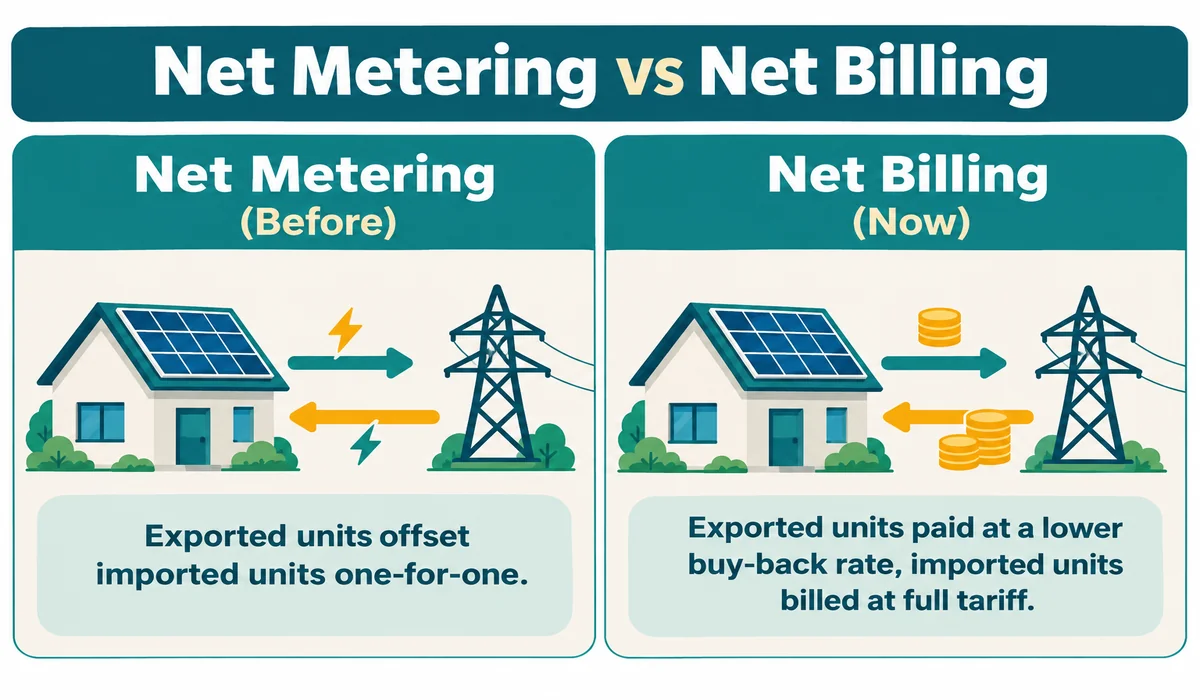
Under the NEPRA (Alternative & Renewable Energy) Distributed Generation and Net Metering Regulations, 2015, electricity exported to the grid and imported from it was adjusted unit-to-unit — one exported unit fully offset one imported unit, and only the net difference was billed. Example: 400 units imported, 300 exported → billed for 100 units only. This made solar financially attractive and drove large-scale investment nationwide.
What Changed on 9 February 2026
NEPRA notified the National Electric Power Regulatory Authority (Prosumer) Regulations, 2026 (S.R.O. 251(I)/2026), issued under Section 47 read with Section 7(1) of the Regulation of Generation, Transmission and Distribution of Electric Power Act, 1997. This repealed the 2015 Net Metering Regulations and introduced Net Billing, discontinuing unit-to-unit adjustment.
How Net Billing Works
Electricity imported from the grid is billed at your full applicable consumer tariff. Electricity exported to the grid is purchased by your DISCO separately, at the National Average Energy Purchase Price (NAEPP) — credited in rupees, not units.
Example: 400 units imported, 300 exported, tariff Rs. 50/unit (mid-range example), NAEPP export rate Rs. 8.13/unit. Import bill: 400 × 50 = Rs. 20,000. Export credit: 300 × 8.13 = Rs. 2,439. Final payable: Rs. 17,561. Under the old net metering system, the same consumer would have paid for only 100 net units — roughly Rs. 5,000. That gap is exactly why existing consumers pushed for protection, and why new installations now need to be sized around self-consumption rather than export.
Note: reported NAEPP export rates have varied across sources — roughly Rs. 8–11/unit for new consumers and Rs. 22–27/unit for existing ones, depending on when the figures were last updated. Always confirm the current rate against your latest bill or NEPRA’s official notification.
Public Reaction & the Prime Minister’s Intervention
After the notification, existing solar consumers — many of whom had invested heavily under the old framework — raised strong objections, and parliamentarians criticised NEPRA and the Power Division publicly. The matter reached the Prime Minister, who directed the Power Division to safeguard existing consumers: protect roughly 466,000 existing solar consumers without unfairly shifting the financial burden onto the more than 38 million consumers on the national grid.
The Power Division’s own position was that non-solar consumers already bear an estimated extra Rs. 2.87/unit in 2026 (projected to reach Rs. 5.35/unit by 2034 under the old framework), and that rapid, unmanaged solarisation risks grid stability — which is why the government held that Net Billing should still apply to new consumers even while protecting existing ones.
The Amendment: What’s Actually Protected
NEPRA published a draft amendment on 16 February 2026, deemed effective from 9 February 2026, clarifying that approvals, licences, concurrences and agreements executed before 9 February 2026 remain valid; existing net-metering consumers continue billing under the old mechanism until their agreement expires, after which renewals fall under the 2026 Prosumer Regulations; and new consumers are fully subject to Net Billing from day one. Consumers with valid pending applications submitted before 8 February 2026 (5,165 applications, totalling 250.822 MW) are also covered under the old terms.
Eligibility & System Requirements
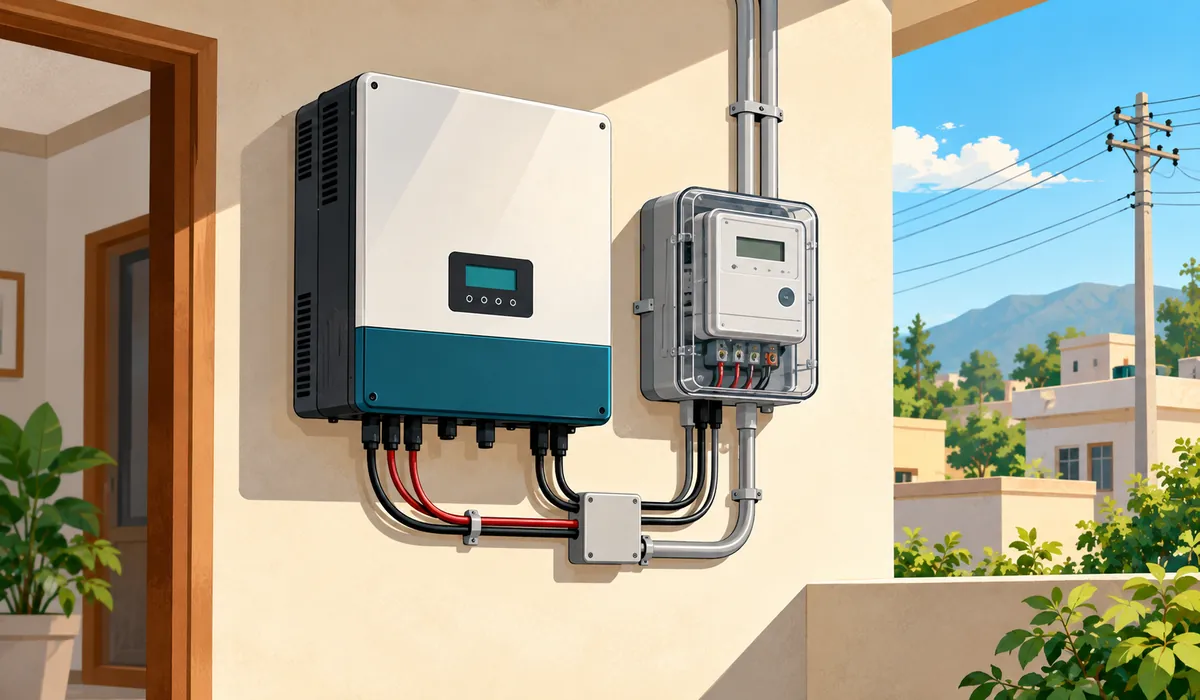
- Minimum system capacity 1 kW, maximum 1 MW
- System capacity can’t exceed your DISCO-sanctioned load
- Three-phase connection required — single-phase consumers must upgrade before applying
- Systems of 250 kW or above require a mandatory load flow study
- No licensing fee up to 25 kW; above that, a one-time Rs. 1,000/kW concurrence fee applies
August 2026 Update: NEPRA Orders Billing Fixes for Stuck Applications
On 19 August 2026, NEPRA issued a directive (Ref: NEPRA/DG(CAD)/TCD-10/1776-23) to PITC — the company running the billing software behind every ex-WAPDA DISCO — following an earlier 31 July 2026 order that NEPRA said was still unimplemented months later. It targets consumers who completed everything required before 9 February 2026 (demand notice paid, licence issued, meter replaced/reprogrammed, MCO agreement executed) but whose bills still weren’t reflecting net metering because the billing system was never updated.
The letter was copied to all 13 DISCOs and licensees — IESCO, FESCO, GEPCO, LESCO, PESCO, MEPCO, HESCO, QESCO, SEPCO, TESCO, HAZECO and K-Electric. If that’s your situation: check your latest bill for whether export credit is being applied, keep proof of your demand notice payment, licence, meter replacement and MCO dates, and if your bill still hasn’t updated, cite NEPRA letter No. NEPRA/DG(CAD)/TCD-10/1776-23 dated 19 August 2026 when you raise it with your DISCO. NEPRA didn’t set a fresh deadline for this fix, so expect some lag before it shows up on an actual bill.
What It Means for You
If You’re an Existing Solar Consumer
Net-metering benefits continue with no immediate billing change, protected by the amendment. Your agreement’s start and expiry date matter most — net billing applies automatically once it lapses. Reported export credit rates for existing agreements have been around Rs. 22–27/unit (commonly cited as Rs. 25.32/unit), and the original agreement term is typically seven years. NEPRA has reserved the right to revise NAEPP during the life of any agreement, including existing ones, so reconfirm your rate periodically against your bill.
If You’re a New Solar Consumer
Net Billing applies from day one, exported energy is worth less financially, and system design should prioritise daytime self-consumption over export capacity — an oversized system reduces your economic return under this model. New agreements typically run for five years, renewable by mutual consent. Export credit for new consumers is commonly cited around Rs. 8.13/unit, but reconfirm the current figure since NEPRA can revise it.
FAQs
Is net metering completely banned?
No. Existing consumers with valid agreements from before 9 February 2026 continue under the old system until their agreement expires.
I installed solar before the change — will my billing change?
Not while your net-metering agreement is valid — you’re protected until it expires.
I’m planning solar now — which system applies?
Net Billing, under the Prosumer Regulations 2026, applies to any new application.
Do exported units still reduce my bill?
Yes, but differently depending on your status: existing consumers keep their contracted per-unit export rate; new consumers are credited in rupees at the current NAEPP rate rather than getting a unit-for-unit offset.
Can my DISCO change my agreement without notice?
No — valid agreements from before 9 February 2026 are protected under NEPRA’s amendment and can’t be unilaterally altered before expiry.
Is solar still worth installing under Net Billing?
Yes, but the economics have shifted — a system sized to cover your own daytime consumption, rather than one built to maximise export, delivers the best return now.
What should I check on my bill?
- Your agreement’s start and expiry date
- The export credit rate shown on your bill
- The billing method noted against your meter reading
- Whether your application was submitted before 8 February 2026, which may qualify you for the old terms
What’s the minimum system size?
1 kW minimum, up to 1 MW maximum, capped at your DISCO-sanctioned load, and it requires a three-phase connection.
In Short
Net Metering has effectively ended for new solar consumers. For existing ones, public pressure and the Prime Minister’s intervention secured legal protection until agreement expiry under NEPRA’s amendment. If you’re weighing solar now, plan around self-consumption rather than export, and if you’re already grandfathered in, know your expiry date and keep an eye on your bill for the correct export credit.
Keep reading
Related guides
AMI Smart Meters & the PTV Fee Removal: What Changed on Your Bill
Two real changes hitting Pakistani electricity bills recently — the shift to AMI smart meters on new connections, and the permanent removal of the Rs. 35…
How to Read a Digital Green Meter
A code-by-code guide to your net-metering meter — what each display code means and which two numbers actually determine your bill.
Prime Minister (PM) Fan Replacement Program 2026 — Complete Step-by-Step Guide
How to apply for NEECA-certified 5-star fans on installment through your electricity bill — and the fine print worth reading before you do.
Put the guide to work
Free tools for all 11 DISCOs. No sign-up, nothing stored.