
How to Read Your Electricity Bill
A section-by-section breakdown of a Pakistani DISCO electricity bill — what each field means and how your total is calculated.
In this guide15 sections
- Why Understanding Your Bill Matters
- 1. Consumer & Connection Information
- 2. Area & Network Information
- 3. Billing Dates & Meter Timeline
- 4. Name & Address Section
- 5. Monthly Consumption History
- 6. Meter Reading Details
- Pro-Rata Billing: When the Meter Isn’t Read on Schedule
- 7. The Charges Section
- How Fixed Charges Work (Updated for SRO 279(I)/2026)
- 8. Government Charges & Taxes
- 9. Bill Calculation, Totals & Due Dates
- 10. QR Code & Subsidy Check
- 11. Complaint & Helpline Information
- In Short
An electricity bill is more than a payable amount — once you understand each section, you can see how your bill is calculated, why it changed from last month, and whether the charges applied are correct. This guide walks through every part of a real Pakistani DISCO bill, including the newer QR-code payment feature and two-tier due dates. The layout, taxes and calculation method described here are standard across all DISCOs — LESCO, FESCO, IESCO, GEPCO, HESCO, MEPCO, PESCO, QESCO, SEPCO, TESCO and HAZECO all use the same structure; only the numbers differ.
Why Understanding Your Bill Matters
Most consumers only look at the total payable amount and skip the breakdown. That makes it hard to notice a sudden increase, a higher tax rate, a fuel price adjustment, or a lost protected-consumer status. Reading the full bill lets you verify charges, catch billing errors early, and plan your usage to avoid crossing into a higher slab.
1. Consumer & Connection Information
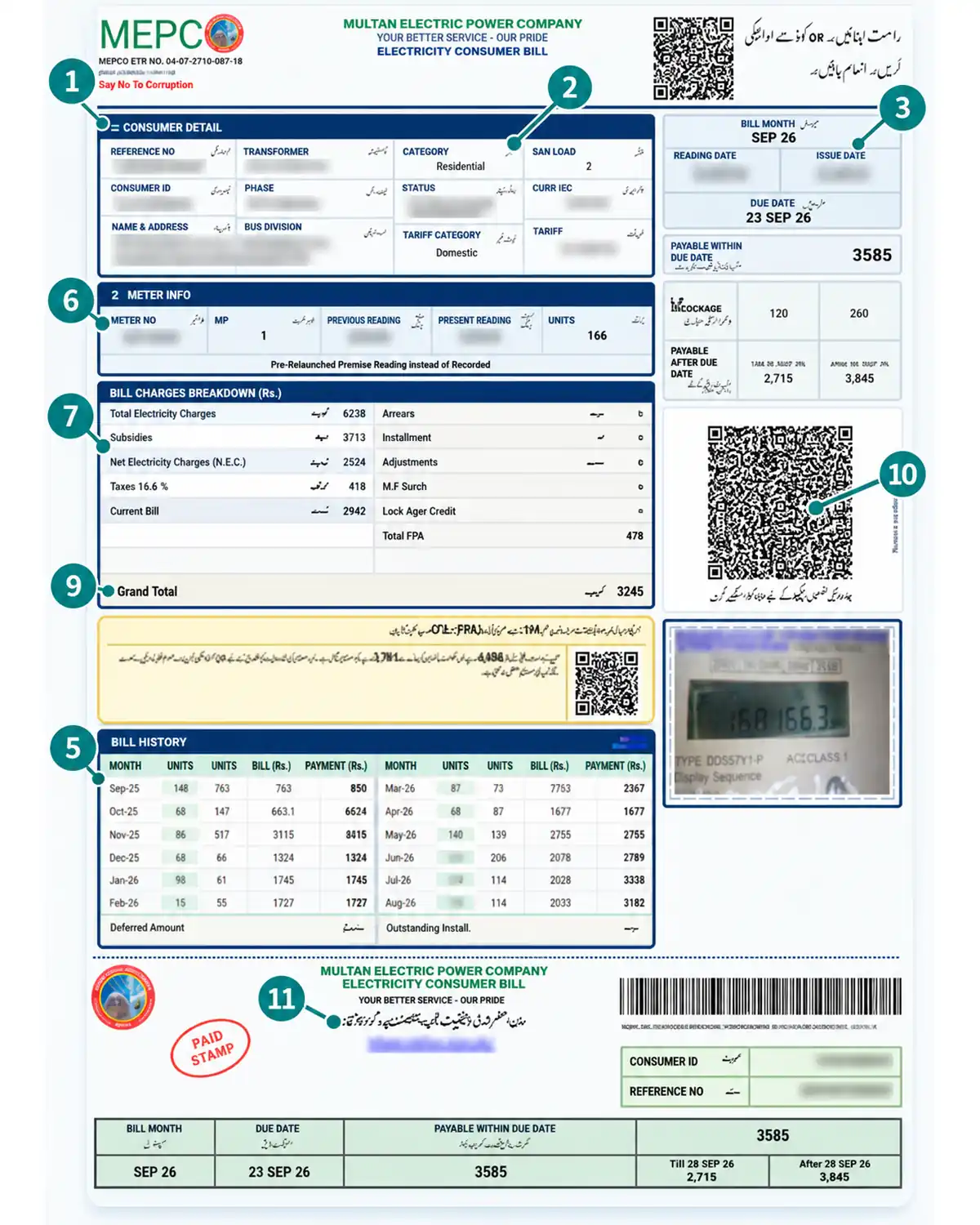
The top block of the bill identifies your account: your Consumer ID (10 digits), your Reference Number (14 digits), your Tariff Code (e.g. A-1a Domestic), your Sanctioned Load in kW, and your old account number if the DISCO migrated systems. The reference number is what you need for online bill checking, online payment, and any complaint or tracking.
2. Area & Network Information
Just below your consumer details, the bill shows your Division, Sub-Division, City, and Feeder Name/Code. This matters because load-shedding schedules are set per feeder, complaints are routed by subdivision, and fault or outage response depends on which feeder you’re connected to.
3. Billing Dates & Meter Timeline
This row lists your Connection Date, Bill Month, Meter Reading Date, Bill Issue Date, and Due Date. These dates determine whether a late payment surcharge applies, whether your bill was delayed, and your window to file a complaint.
4. Name & Address Section
This confirms billing ownership: consumer name, father’s/husband’s name, and complete address. If any of this is wrong, the correction has to be requested in person at your local subdivision office — it can’t be changed from the bill checker.
5. Monthly Consumption History
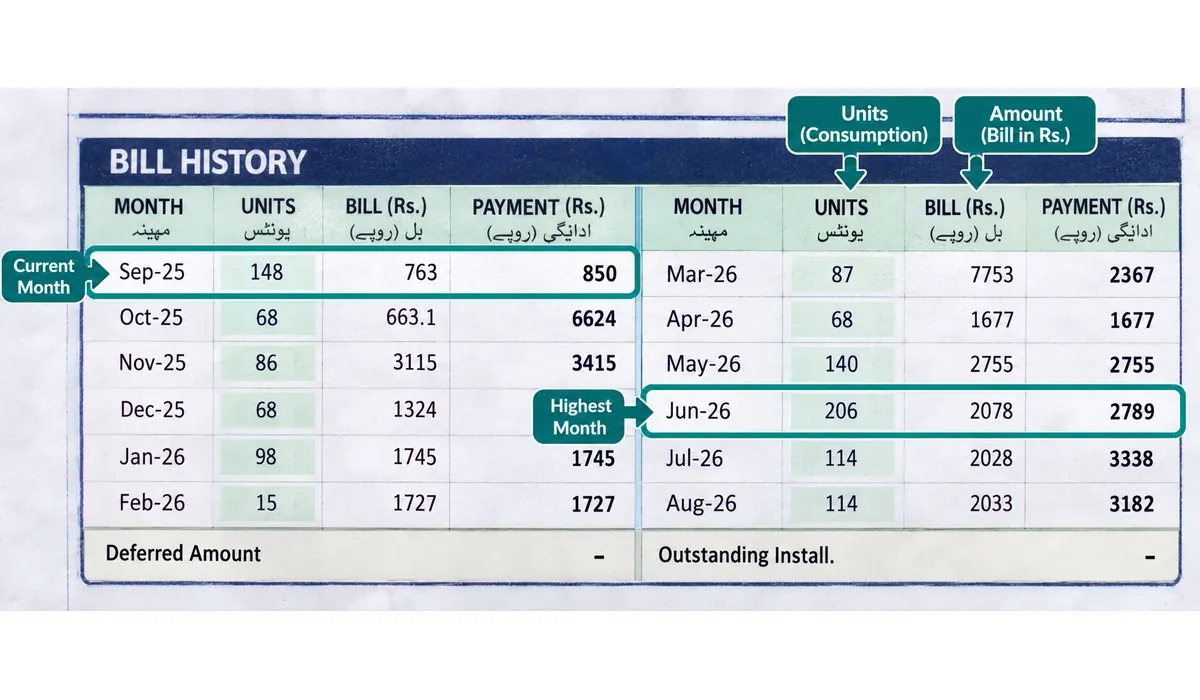
A table of your last several months — units consumed, bill amount, and payment status. Use it to check whether your units stayed within the protected-consumer threshold over the last six months, compare seasonal usage (summer vs winter), catch an abnormal spike that could cost you your subsidy status, and plan ahead to avoid crossing a slab boundary.
6. Meter Reading Details
This section shows your Meter Number, Previous Reading, Present Reading, MF (Multiplier Factor) and Units Consumed. The formula is straightforward:
(Current Reading − Previous Reading) × MF = Units Consumed
Pro-Rata Billing: When the Meter Isn’t Read on Schedule
Pro-rata billing adjusts your bill when the actual gap between meter readings is longer or shorter than the standard 30-day cycle — typically because of a delayed reading. Two worked examples:
More Than 30 Days
Your meter was read after 33 days instead of 30, and you actually used 210 units. Adjusted units = 210 ÷ 33 × 30 = 190.91, billed as 191 units (rounded). This prevents you being overcharged for the extra days.
Less Than 30 Days
Your meter was read after only 27 days, and you used 180 units. Adjusted units = 180 ÷ 27 × 30 = 200 units billed. This prevents you being undercharged, which would otherwise just shift the shortfall onto next month’s bill.
If your bill includes this adjustment, it’s usually noted directly as something like “Billing for more than 30 days (pro-rata).” It’s a standard, automatic correction — not an error.
7. The Charges Section
This is where your electricity cost is actually built: Units Consumed × rate for Cost of Electricity, plus Fixed Charges, the Fuel Price Adjustment (FPA), Quarterly Tariff Adjustment (QTA/DMC), and FC Surcharge. All of these are NEPRA-approved rates applied nationwide — your DISCO doesn’t set them independently.
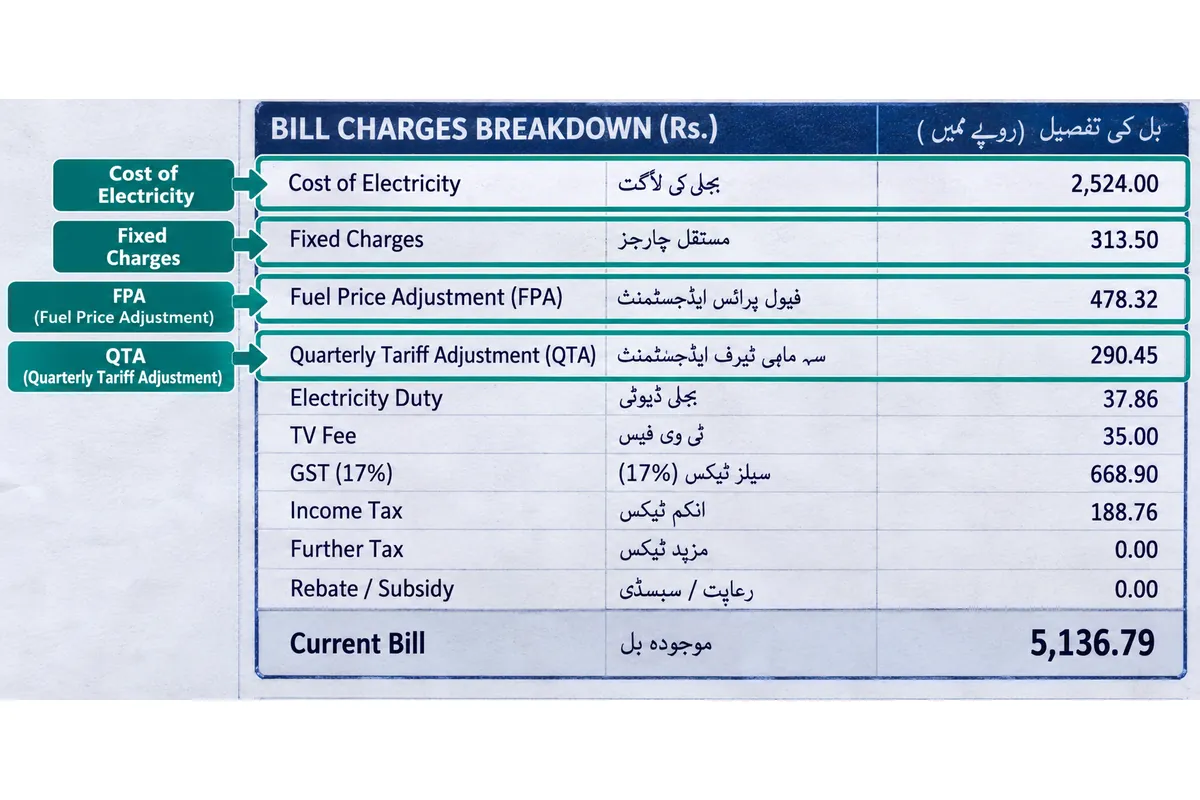
FPA in particular is worth understanding on its own, since it’s the line that makes your bill change even when your usage doesn’t — see our full FPA guide for how it’s calculated and why it lags your actual usage month by two months.
How Fixed Charges Work (Updated for SRO 279(I)/2026)
Effective 12 February 2026, NEPRA restructured residential fixed charges under S.R.O. 279(I)/2026: instead of a flat Rs./consumer/month rate, fixed charges are now tied to your Sanctioned Load in Rs./kW/month. The more load you have sanctioned — regardless of how many units you actually use — the more you pay in fixed charges every month. This change applies to residential connections only; Commercial, Industrial and Agricultural fixed charges remain on the previous schedule, and Lifeline consumers (up to 50 units/month) still pay zero fixed charges.
Regular (Non-ToU) Residential — Tariff A1
For standard domestic connections: Sanctioned Load (kW) × Applicable Fixed Charge Rate (Rs./kW/month) = Total Fixed Charge. The rate depends on your consumption slab and whether you’re Protected or Unprotected:
| Category | Consumption Slab | Fixed Charge (Rs./kW/month) |
|---|---|---|
| Protected | Up to 50 units (Lifeline) | 0 |
| Protected | 51–100 units (Lifeline) | 0 |
| Protected | 1–100 units | 200 |
| Protected | 101–200 units | 300 |
| Unprotected | 1–100 units | 275 |
| Unprotected | 101–200 units | 300 |
| Unprotected | 201–300 units | 350 |
| Unprotected | 301–400 units | 400 |
| Unprotected | 401–500 units | 500 |
| Unprotected | 501–700 units | 675 |
| Unprotected | Above 700 units | 675 |
Example: two consumers each use exactly 100 units with a 2 kW sanctioned load. A Protected consumer pays 2 × Rs. 200 = Rs. 400 in fixed charges; an Unprotected consumer at the same usage pays 2 × Rs. 275 = Rs. 550 — a Rs. 150 difference purely from protection status, not consumption.
Time-of-Use (ToU) Residential Consumers
For consumers with a peak load above 5 kW billed on Peak/Off-Peak rates, the fixed charge rate is Rs. 675/kW/month, but the kW figure used is the higher of 50% of your sanctioned load or your actual recorded Maximum Demand Indicator (MDI) — the highest demand your meter recorded in that billing month. Example: sanctioned load 6 kW (50% = 3 kW), MDI recorded 4 kW. Since 4 kW > 3 kW, the bill uses 4 kW × Rs. 675 = Rs. 2,700 fixed charge.
Check Your Sanctioned Load
Because fixed charges are now multiplied directly by sanctioned load, an oversized load figure can quietly inflate your bill every month even when you barely use electricity. Find the “Sanctioned Load (kW)” field on your bill, add up the real wattage of appliances you regularly run, and if your sanctioned load is well above what you actually need, apply to your DISCO to revise it downward — even 1–2 kW less can save hundreds of rupees a month, permanently.
8. Government Charges & Taxes
| Tax | How It’s Calculated |
|---|---|
| Electricity Duty (ED) | % of energy charges |
| GST | % of bill amount |
| Income Tax | Mostly commercial / high-usage connections |
| Extra Tax | Specific consumer categories |
| Further Tax | Certain unregistered categories |
| Retailer Tax | Business connections |
Your DISCO collects these on the government’s behalf — it doesn’t keep them. The PTV licence fee field may still print on some bills, but the amount itself has been zero since it was formally removed in July 2025.
9. Bill Calculation, Totals & Due Dates
The calculation box shows the base energy cost as GoP Tariff × Units (for example, 10.54 × 74 for a Protected consumer’s 1–100 unit rate) before taxes and adjustments. The totals block then combines the current bill, any arrears, installments and subsidies into your final Payable Amount.
Most DISCO bills now show two due dates: pay within the first due date and there’s no penalty; pay after it and a Late Payment Surcharge (LPS) applies, often in two escalating tiers. Always aim for the first due date.
10. QR Code & Subsidy Check
A QR code on the bill lets you scan and pay directly through mobile banking, avoiding late-payment risk. A separate QR/banner may also let consumers using 200 units or less check their eligibility for the government’s Cross Subsidy Program — see our Cross Subsidy Program guide for how to register.
11. Complaint & Helpline Information
Every bill lists the shared 118 helpline, SMS 8118, and the NEPRA Asaan Approach app for reporting overbilling, wrong readings or service complaints. See our billing complaint guide for the full process, including when to escalate to NEPRA directly.
In Short
Once you can read the full bill, you can verify your charges, confirm your units, catch penalties before they hit, and spot billing errors early. This structure applies to nearly every electricity bill issued in Pakistan — not just one DISCO.
Keep reading
Related guides
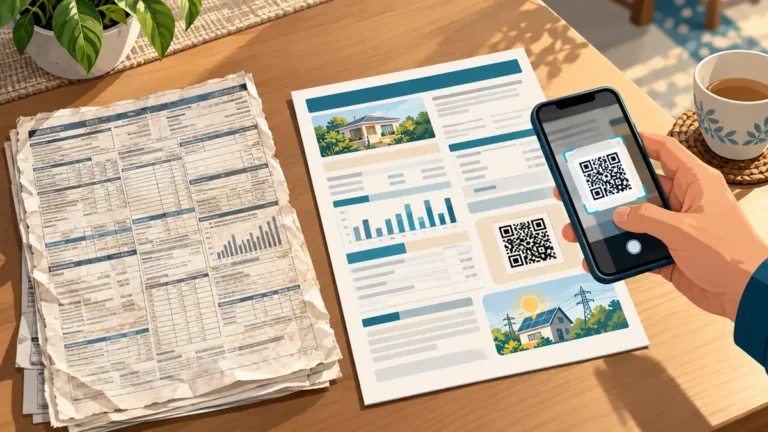
Government Introduces New Electricity Bill Format Across All DISCOs (2026 Guide)
What changed in the redesigned bill layout, what the new QR codes actually do, and whether your rates are affected.
What is FPA in Electricity Bill? The Complete Pakistan Guide
If your bill jumped but your usage barely changed, FPA is usually why. Here's what it actually is, how it's calculated, and when you can legitimately…
Electricity Tariff Guide: Latest Unit Rates & Slabs (NEPRA)
The full NEPRA-notified tariff schedule that applies nationwide — domestic, commercial, industrial, agricultural and other consumer categories, current as of S.R.O. 279(I)/2026.
Put the guide to work
Free tools for all 11 DISCOs. No sign-up, nothing stored.