
What is FPA in Electricity Bill? The Complete Pakistan Guide
If your bill jumped but your usage barely changed, FPA is usually why. Here’s what it actually is, how it’s calculated, and when you can legitimately dispute it.
In this guide15 sections
- What Does FPA Stand For?
- How FPA Reaches Your Bill
- How to Find It on Your Bill
- How to Calculate It
- Why FPA Changes Every Month
- What Is Negative FPA?
- FPA vs FC Surcharge
- GST on FPA
- FPA for Protected Consumers (0–200 Units)
- FPA and Solar Prosumers — 2026 Policy Update
- Is FPA Different Across DISCOs?
- The Lahore High Court Ruling — What It Means for You
- Can You Dispute an FPA Charge?
- FAQs
- In Short
FPA is one of the most complained-about lines on a Pakistani DISCO bill — and one of the least explained. This guide covers what it actually is, how NEPRA calculates it, why it changes every month, what a negative FPA means for your wallet, how it differs from the FC surcharge, and when you have legitimate grounds to dispute it.
What Does FPA Stand For?
FPA stands for Fuel Price Adjustment: a variable monthly charge reflecting the actual cost of fuel used to generate electricity during a given period, compared with the cost NEPRA assumed when it set the standard tariff. NEPRA fixes a base tariff using an estimated fuel cost; if actual gas, oil, LNG or coal prices come in higher, you pay the difference through FPA. If they come in lower, you get a credit — a negative FPA. It isn’t a fixed charge, a penalty, or a tax — it’s a cost pass-through mechanism. You’ll find it as a separate line just below your base tariff charge.
How FPA Reaches Your Bill
Pakistan generates electricity from a mix of hydropower, gas, oil, coal and LNG. The fuel-based plants have running costs that move with global and domestic fuel prices, and the charge reaches your bill in four steps:
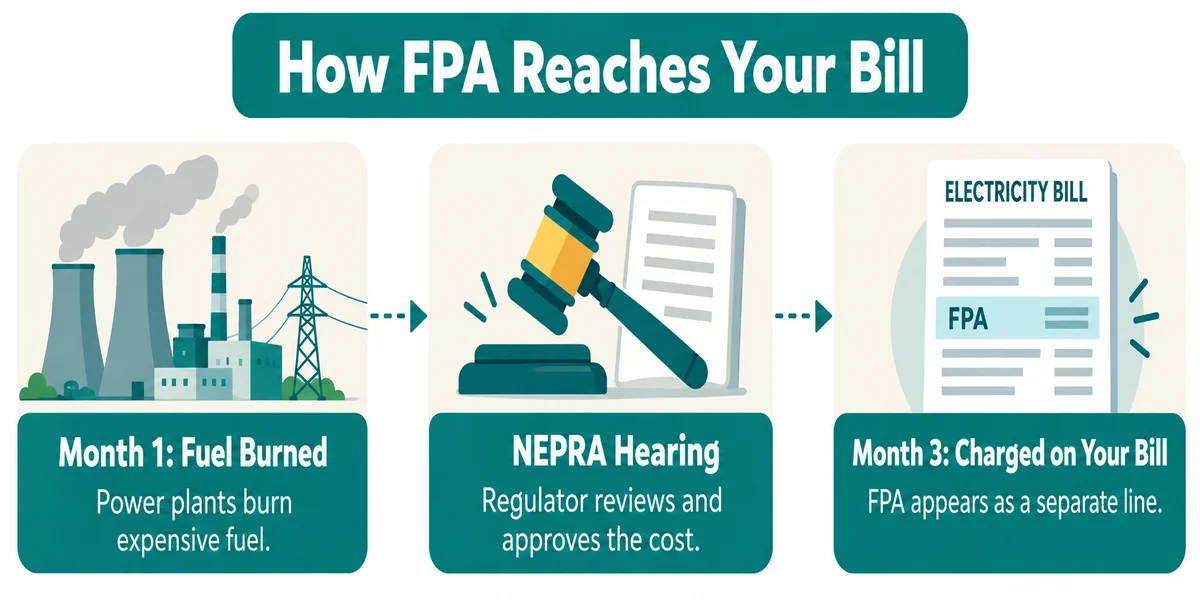
1. Power plants report fuel costs. Each month, IPPs and public-sector generation companies submit actual fuel cost data to NEPRA.
2. NEPRA runs a determination. NEPRA compares these costs against the reference fuel prices built into the existing tariff; the difference per unit becomes the FPA rate.
3. There’s a 2–3 month lag. NEPRA needs time to collect data, hold a determination hearing, and notify DISCOs — so the FPA on your bill today usually reflects fuel costs from 2–3 months earlier.
4. Your DISCO applies it. Whichever DISCO bills you — HAZECO, PESCO, IESCO, MEPCO, LESCO, FESCO, GEPCO, HESCO, QESCO, SEPCO or TESCO — applies the same NEPRA-approved rate to your consumed units.
This lag is why a large FPA charge can show up on your bill even in a month when fuel prices seem to have settled — you’re being charged for a period several months back.
How to Find It on Your Bill
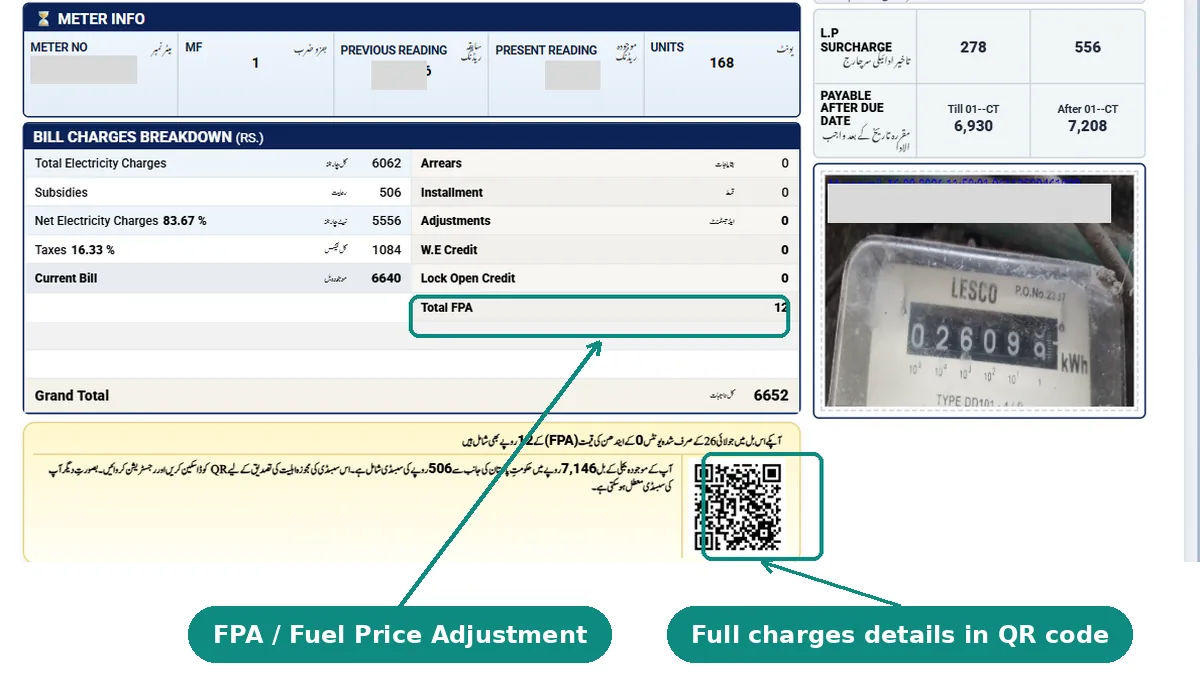
Look for “F.P.A.” or “Fuel Price Adj.” for the main charge, “GST on F.P.A.” for the 18% tax on top of it, and “F.C. Surcharge” — a separate charge often confused with FPA (see below). The FPA line shows a positive value when fuel costs ran above the tariff reference price, and a negative value (in brackets or with a minus sign) when they ran below it.
How to Calculate It
FPA Charge (Rs.) = Units Consumed (in the NEPRA-specified prior month) × FPA Rate (Rs./kWh)
Worked example: 350 units consumed, FPA rate of Rs. 3.21/unit → 350 × 3.21 = Rs. 1,123.50. Add 18% GST on that (Rs. 202.23) and the combined FPA-related charge is Rs. 1,325.73 — on top of your regular tariff charges. In a high-rate month, that alone can add Rs. 1,000–2,000 to a mid-sized household bill, which is exactly the kind of jump that makes usage-flat, bill-up months feel confusing.
Check the current published rate and estimate your own charge using our FPA Tracker.
Why FPA Changes Every Month
Global fuel prices: Pakistan imports a large share of its LNG and furnace oil, so international price swings from supply disruptions or geopolitical events feed straight into generation cost.
The energy mix that month: hydropower is cheap and fuel-free, so FPA tends to fall during monsoon season (July–September) when hydro output is high, and rise in winter/dry periods when more oil and gas plants run.
Exchange rate movement: fuel imports are priced in US dollars, so a weaker rupee raises the rupee cost of the same barrel of oil — and that passes straight through to FPA.
What Is Negative FPA?
FPA can go negative when actual fuel costs come in below the reference price in your tariff — NEPRA then requires DISCOs to pass the saving back as a deduction on your bill, shown as a negative value or a bracketed figure. Pakistan saw negative FPA in parts of 2023 when hydro generation was unusually high and LNG spot prices softened; a Rs. −2.50/unit FPA on a 300-unit bill would mean a Rs. 750 reduction that month. It doesn’t carry forward — each month is its own determination.
FPA vs FC Surcharge
These sit next to each other on the bill and both relate to fuel, but they aren’t the same. FPA is set by NEPRA, changes monthly, and can be positive or negative — its legal basis is the NEPRA Act, Section 31. The FC (Fuel Cost) Surcharge is a government-set, largely fixed levy that funds past energy-sector debt, always positive, and stays fixed until the government revises it. FPA varies with market conditions; the FC surcharge doesn’t.
GST on FPA
Once FPA is calculated, 18% GST is applied on top of it — a frequent source of frustration, since it’s a tax on an adjustment charge. Using the earlier example: Rs. 1,123.50 FPA + Rs. 202.23 GST = Rs. 1,325.73 combined. When FPA goes negative, GST on FPA goes negative too, so a credit month reduces your tax burden as well.
FPA for Protected Consumers (0–200 Units)
Consumers using 200 units or fewer a month are classified as protected under NEPRA’s tariff structure and get a subsidised base rate; within that, 100 units or fewer falls under Lifeline, which is subsidised further. But the FPA rate itself is set uniformly by NEPRA across all categories — the protected/Lifeline subsidy covers your base tariff only, not the FPA component. If you’re a protected consumer and FPA is showing at the full commercial rate, that’s worth raising with your DISCO as a possible classification error.
FPA and Solar Prosumers — 2026 Policy Update
Pakistan’s billing structure for solar consumers changed in February 2026. If you registered as a prosumer before 9 February 2026, your contract terms are protected — you keep the previous net metering rates and unit-for-unit offset until your agreement expires, and FPA applies only to your net imported units, unless you materially upgrade your system capacity (which ends the grandfathered terms). If you registered after 9 February 2026, you fall under the Prosumer Regulations 2026 and net billing: your solar generation is purchased by the DISCO at the NAEPP rate of Rs. 8.13/unit, grid electricity is charged at the applicable tariff, and FPA applies to every unit imported from the grid since there’s no unit-for-unit offset. Either way, FPA is only ever charged on units imported from the grid, never on what your panels generate — the difference is just how ‘net’ is defined under your specific agreement.
Is FPA Different Across DISCOs?
The rate per unit is set nationally by NEPRA and applies uniformly across MEPCO, LESCO, FESCO, IESCO, HESCO, PESCO, SEPCO, QESCO, TESCO and HAZECO. What can differ between DISCOs is meter reading accuracy (an estimated bill with wrong units means wrong FPA too), billing cycle timing (a just-published determination might land in the next cycle rather than the current one), and how accurately a DISCO maintains protected-consumer records. K-Electric sits outside this entirely — it’s billed directly by NEPRA under a separate regulatory framework, so its FPA timing can occasionally differ by a cycle from ex-WAPDA DISCOs.
The Lahore High Court Ruling — What It Means for You
In 2023, the Lahore High Court ruled that FPA lacked proper statutory foundation under the NEPRA Act. In October 2023, the Supreme Court overturned that ruling, calling it “impractical both constitutionally and legally,” and held that technical NEPRA matters belong before the NEPRA Appellate Tribunal, not a high court. FPA collection continued throughout and remains in force today. If you believe FPA was charged incorrectly in a specific period, the proper channel is the NEPRA Appellate Tribunal — you can also file a billing-error complaint with NEPRA Consumer Services at 0800-63772 (toll-free) or via nepra.org.pk.
Can You Dispute an FPA Charge?
You can, in specific circumstances: your consumer category is wrong (you should be protected but were charged at the unprotected rate), your units were estimated rather than actually read, the rate applied doesn’t match NEPRA’s published determination for that month, or you want to challenge it on legal grounds via the NEPRA Appellate Tribunal. Document the complaint in writing and keep the bill in question — see our billing complaint guide for the full escalation process.
FAQs
Can FPA be negative on my bill?
Yes — when actual fuel costs come in below NEPRA’s reference price, it appears as a deduction that reduces your payable amount for that month.
Why is the FPA on my bill from two months ago?
Because of the reporting-to-determination lag described above — the FPA you pay today usually reflects fuel costs from roughly 2–3 months earlier.
Is FPA the same as ‘fuel adjustment charge’?
Yes — different DISCOs abbreviate it differently on the printout, but it’s the same NEPRA-approved line item.
Does FPA apply to commercial and industrial consumers?
Yes, at the same per-unit rate as residential — their total is simply higher because their consumption is higher.
Can I reduce my FPA charges?
You can’t negotiate the rate, but since it’s charged per unit, using less electricity directly reduces your exposure. Solar (reducing net imported units) is currently the most effective structural way to cut it.
Is the FPA rate the same across LESCO, MEPCO, FESCO and other DISCOs?
Yes — the rate per unit is set nationally by NEPRA. Your total differs only because your consumption differs.
In Short
FPA isn’t arbitrary — it’s the real difference between what Pakistan’s power plants actually spent on fuel and what NEPRA estimated when the tariff was set. When oil prices spike, the rupee weakens, or hydro output drops, that gap widens and your bill reflects it. What’s genuinely worth checking is whether your consumer category is correct and whether your meter is being read accurately — those are the two places real billing errors happen. Monitoring your units, verifying your consumer category with your DISCO, and considering solar if you’re a heavy user are the most practical ways to keep FPA under control.
Sources: NEPRA monthly determinations, DISCO billing guidelines, Supreme Court judgment dated 16 October 2023 (FPA ruling).
Keep reading
Related guides
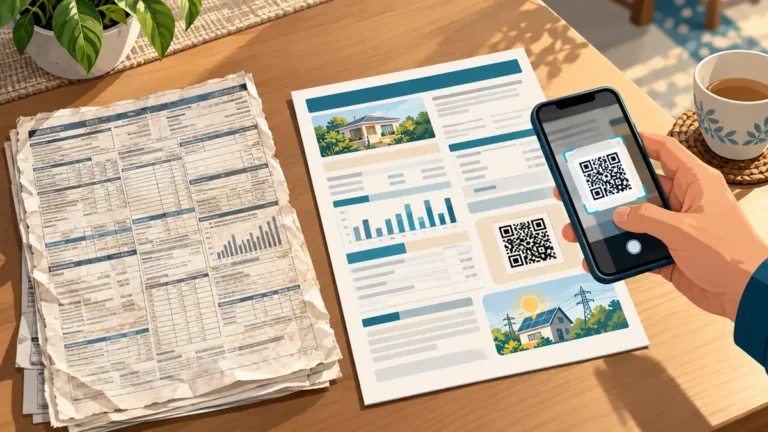
Government Introduces New Electricity Bill Format Across All DISCOs (2026 Guide)
What changed in the redesigned bill layout, what the new QR codes actually do, and whether your rates are affected.

How to Read Your Electricity Bill
A section-by-section breakdown of a Pakistani DISCO electricity bill — what each field means and how your total is calculated.

Electricity Tariff Guide: Latest Unit Rates & Slabs (NEPRA)
The full NEPRA-notified tariff schedule that applies nationwide — domestic, commercial, industrial, agricultural and other consumer categories, current as of S.R.O. 279(I)/2026.
Put the guide to work
Free tools for all 11 DISCOs. No sign-up, nothing stored.